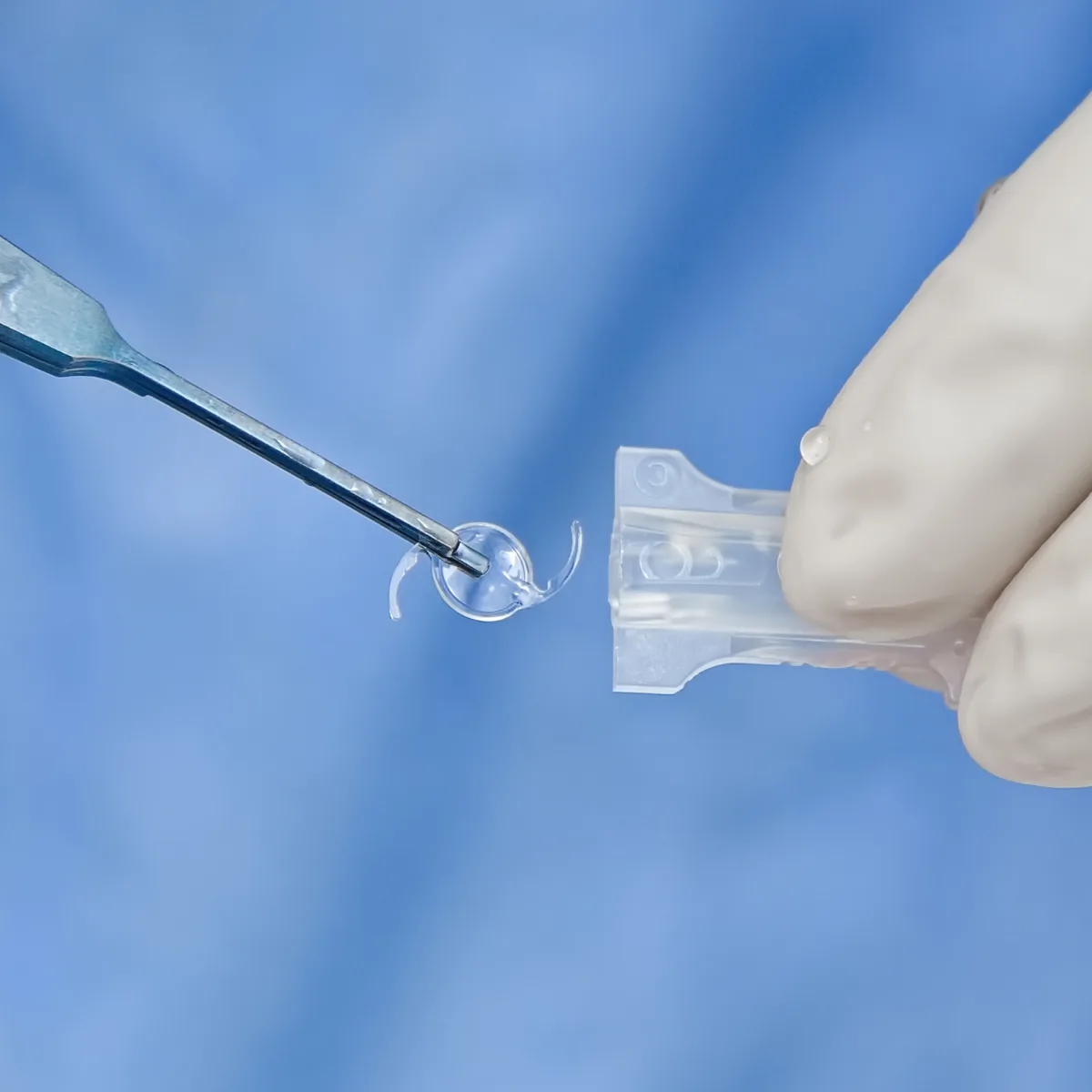
Clear lens exchange, sometimes called PreLEx, involves replacing the natural crystalline lens with an implant that corrects vision. Similar in principle to cataract surgery, it addresses specific refractive indications, particularly after the age of 50. The decision is made following a full assessment.
Clear lens exchange involves removing the natural crystalline lens, the transparent lens inside the eye, and replacing it with an intraocular implant chosen to correct the visual defect. The principle is very close to that of cataract surgery; what differs here is the objective, which is refractive: to correct vision, in particular presbyopia. [TO BE VALIDATED BY THE PRACTITIONER: technical description]
Once the crystalline lens has been replaced by an implant, the correction is provided by that implant, selected on a bespoke basis according to your eye and your visual needs.
By replacing the crystalline lens with an implant, this procedure corrects vision and also removes the risk of cataract, since the natural lens, which could become cloudy with age, is no longer present.
Schematic, non-anatomical illustration of the replacement of the natural crystalline lens with an intraocular implant.
What is the link with cataract?
The technique is very similar to cataract surgery: in both cases, the crystalline lens is removed and replaced by an implant. The difference lies in the indication. In cataract, the lens has become cloudy and impairs vision; in refractive lens exchange, the lens is not necessarily cloudy, and the procedure aims primarily to correct vision, in particular presbyopia. For further information, see also the Cataract surgery page and the Intraocular lenses page.
Who is it for?
The indication is established following a full assessment. Clear lens exchange may be considered in particular:
after the age of 50, when presbyopia is established; [TO BE VALIDATED: age and indications]
in the presence of early clouding of the crystalline lens;
in a patient whose eye presents the required characteristics, with no contraindication identified at assessment.
Which implants?
Several types of implant exist. The choice is made on a case-by-case basis, following assessment, according to your eye, your visual priorities and your lifestyle. [TO BE VALIDATED: implants actually offered]
Monofocal implant
It provides clear vision at one principal distance, most often for distance vision. An additional correction may remain useful for near vision.
Extended depth of focus implant (EDOF)
It aims to extend the range of clear vision, particularly for distance and intermediate distances.
Multifocal implant
It seeks to provide clear vision at several distances, both far and near, to reduce dependence on glasses. It requires an adaptation period and is the subject of detailed information.
No implant is "the best" in absolute terms: the right implant is the one that matches your eye and your needs, determined with you following assessment.
How does the procedure work?
The procedure is most often performed under local anaesthetic, as a day case, one eye at a time. It is brief.
1
Preparation and anaesthesia
Local anaesthetic, most often administered as eye drops.
2
Lens removal
The natural crystalline lens is removed through a micro-incision, using a technique similar to cataract surgery.
3
Implant placement
The chosen implant is introduced, folded, then positioned in place of the crystalline lens.
4
Verification and completion
The correct positioning of the implant is confirmed before the procedure is concluded.
What are the recovery and aftercare like?
Recovery and visual rehabilitation are discussed during the consultation and depend on each individual eye and the type of implant. A close post-operative follow-up is arranged.
eye drops prescribed to support healing;
rest and eye protection for the first few days;
an adaptation period may be required, particularly with certain implants;
return to activities in accordance with instructions given during the consultation;
scheduled follow-up appointments.
Key points to know
Clear lens exchange is intraocular surgery; the expected benefits and limitations are explained to you during the consultation. The choice of implant is critical and is made with you, according to your visual priorities. As with other refractive techniques, no solution is superior in absolute terms: everything depends on your eye and your individual situation.
How does management work with Dr Gattoussi?
The process is gradual and without commitment: a full assessment with eye imaging and precise measurements, choice of implant and detailed information, the procedure if indicated, followed by close post-operative follow-up. Dr Gattoussi's expertise in eye imaging allows for a precise pre-operative evaluation and an appropriate choice of implant.
Frequently asked questions
Do I need to have a cataract for this procedure?
No. Clear lens exchange can have a refractive objective, even without an established cataract. The indication is determined at assessment.
Can cataract develop again afterwards?
Since the crystalline lens is replaced by an implant, true cataract does not recur. However, a thin membrane behind the implant may become cloudy over time and is treated simply with a laser.
How is the implant chosen?
The choice is made with you, following assessment, according to your eye, your vision priorities (distance, intermediate, near) and your lifestyle.
Is this procedure covered by health insurance?
Coverage depends on the indication. When a cataract is present, a portion may be covered; for a purely refractive indication, this is generally not the case. Details are provided during the consultation.