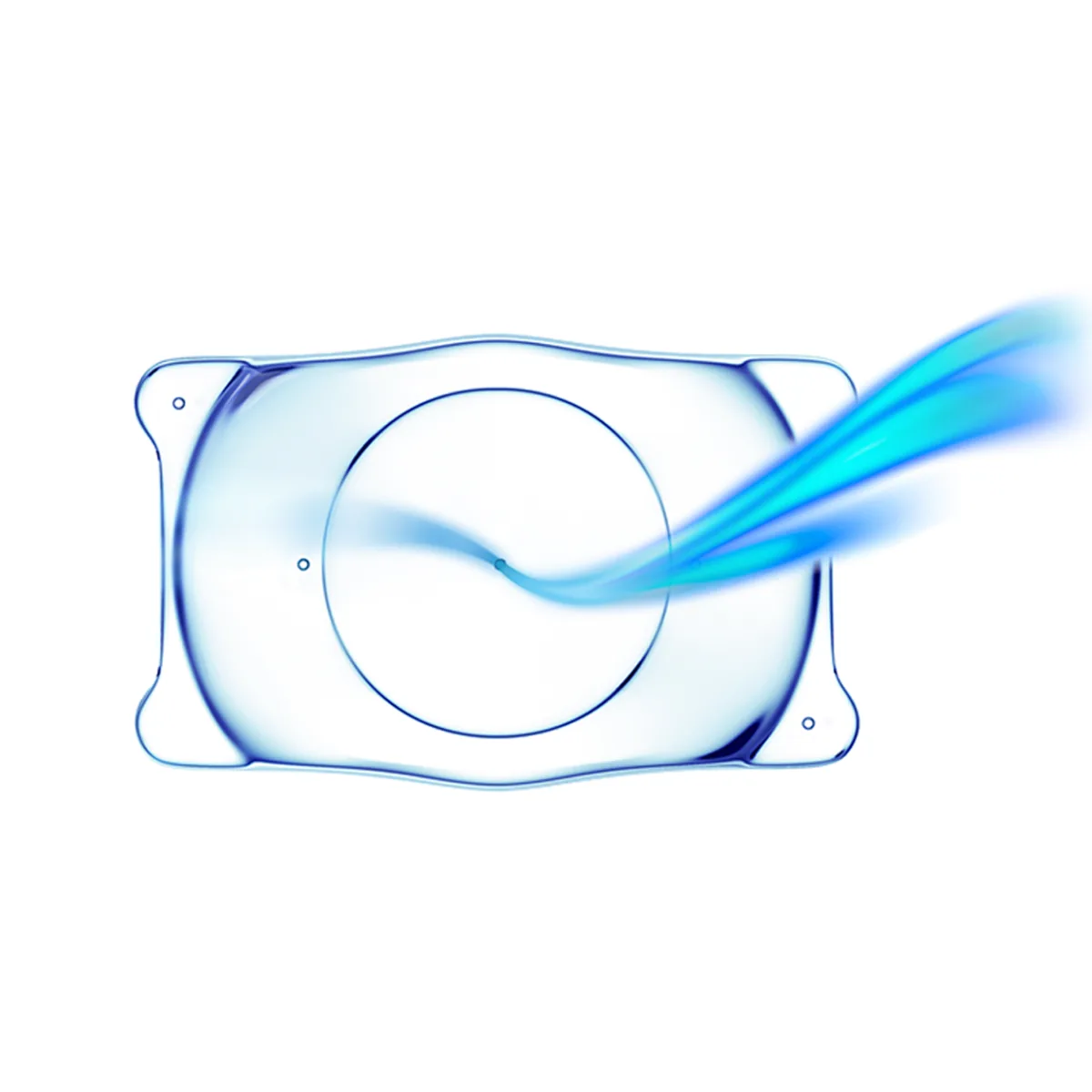
A phakic IOL, or ICL, is a lens placed inside the eye without removing the natural crystalline lens. It is an alternative to laser surgery for certain corrections, particularly high refractive errors. The indication is decided after a complete pre-operative assessment.
A phakic IOL is a thin, biocompatible lens inserted inside the eye whilst preserving the natural crystalline lens, which remains in place. The word "phakic" means precisely that the crystalline lens is not removed. This lens corrects the visual defect in a manner comparable to a contact lens, but placed permanently inside the eye. [TO BE VALIDATED: technical description]
The best-known implant is designated by the acronym ICL (Implantable Collamer Lens). It is particularly suited to high prescriptions and eyes for which laser is not the most appropriate option.
The phakic IOL adds a lens inside the eye without touching the cornea or the crystalline lens. It is a reversible correction: the implant can, if necessary, be removed or replaced.
Schematic, non-anatomical illustration of the position of the phakic IOL, in front of the preserved natural crystalline lens.
How does it differ from laser?
Unlike laser, which reshapes the cornea by removing a small amount of tissue, the phakic IOL does not modify the corneal tissue: it adds a corrective lens inside the eye. This approach may be proposed when laser is not the most appropriate option, for example in cases of high myopia or a cornea too thin to be safely reshaped.
Phakic IOL or lens replacement?
Both techniques place a lens inside the eye, but they treat the crystalline lens differently. The choice depends notably on age and the condition of the lens.
The phakic IOL
The natural crystalline lens is preserved: the lens is added in front of it. Often considered in younger adults, for high prescriptions. The correction is reversible.
The natural crystalline lens is removed and replaced by an implant, as in cataract surgery. More commonly considered from a certain age or in the presence of early cataract.
No technique is "the best" in absolute terms: the right solution is the one that suits your eye and your situation, determined by the pre-operative assessment.
Who is it for?
The indication is established after a complete assessment. A phakic IOL may be considered notably:
in cases of high myopia, hyperopia or astigmatism;
when the cornea does not permit laser (for example, a cornea that is too thin);
in a patient whose eye has the required anatomical characteristics (sufficient internal space);
generally in younger adults with a still-clear crystalline lens.
How does the procedure work?
The implant is introduced folded in a cartridge through a micro-incision, then unfolds inside the eye. The procedure is brief, most often under local anaesthesia.
1
Preparation and anaesthesia
Local anaesthesia, most often with eye drops.
2
Micro-incision
A small incision is made to access the interior of the eye.
3
Implant placement
The folded lens is introduced and positioned in front of the natural crystalline lens.
4
Verification and completion
Correct positioning of the implant is confirmed before the end of the procedure.
What is the recovery like?
Visual recovery and aftercare are discussed at the consultation and depend on each individual eye. Close post-operative follow-up is arranged. The implant can, if necessary, be removed or replaced, making the correction reversible.
prescribed eye drops to support healing;
rest and eye protection for the first few days;
return to activities in accordance with the advice given at the consultation;
scheduled follow-up appointments.
Key points to know
The phakic IOL and laser address different situations: one is not superior to the other. The implant has the advantage of preserving the cornea and being reversible, but it involves surgery inside the eye, and the expected benefits and limitations are fully explained at the consultation.
How is care managed with Dr Gattoussi?
The approach is gradual and without commitment: complete assessment with ocular imaging, precise measurements of the eye's internal dimensions, information and shared decision, procedure if the indication is confirmed, then post-operative follow-up. Dr Gattoussi's expertise in ocular imaging enables a particularly precise pre-operative evaluation.
Frequently asked questions
Is the implant visible or perceptible?
The implant is placed inside the eye and is neither visible from the outside nor perceived in daily life.
Is the implant permanent?
The implant can remain in place long-term, but the correction is reversible: it can be removed or replaced if necessary.
What is the difference from lens replacement?
The phakic IOL preserves the natural crystalline lens and is placed in front of it. Lens replacement removes the crystalline lens and replaces it with an implant. The choice depends notably on age and the condition of the lens.
Is the phakic IOL covered by insurance?
Refractive surgery is generally not covered by the French national health insurance. Some supplementary health plans offer a fixed contribution.