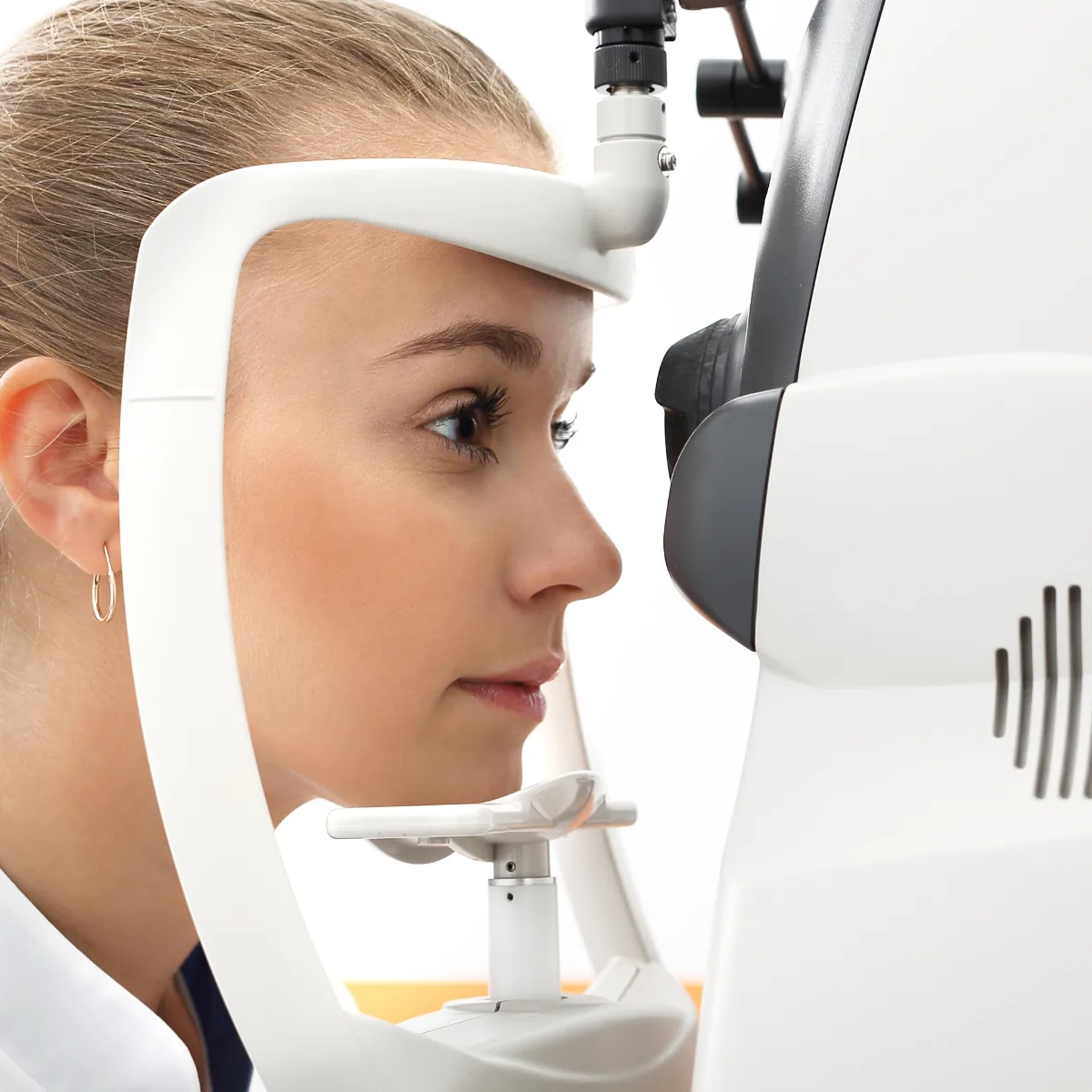
Hyperopia mainly affects near vision, and sometimes distance vision too. The eye is slightly too short or its cornea too flat: the image forms behind the retina. It can be corrected with glasses, contact lenses or, depending on assessment, by laser.
Hyperopia is a common visual condition in which the eye does not have sufficient optical power relative to its length: either the eye is slightly too short, or its cornea is too flat. Light therefore focuses behind the retina rather than precisely on it. The resulting image is blurred, first at near distance, and sometimes also at distance when hyperopia is significant.
To compensate, the eye makes a constant effort called accommodation. In children and young adults, this effort often masks hyperopia; with age, it becomes less effective and the difficulty becomes apparent.
Hyperopia is the opposite of myopia: the short-sighted person sees blurrily at distance, while the hyperopic person struggles primarily with near vision.
Which signs should alert you?
blurred near vision, worsening towards the end of the day;
visual fatigue and headaches after reading or screen use;
the need to hold text further away to read it more clearly;
sometimes blurred distance vision when hyperopia is significant;
in children, sometimes an associated squint.
An ophthalmic assessment measures the hyperopia precisely so that the most appropriate correction can be proposed.
Diagram: the hyperopic eye, being too short, focuses the image behind the retina. Correction brings the focal point onto the retina. Non-anatomical illustration.
What causes it?
Hyperopia is most often constitutional: the eye is naturally slightly too short or its cornea insufficiently curved, with a hereditary component. Most young children are mildly hyperopic, which usually resolves spontaneously as the eye grows. When hyperopia persists, it often becomes apparent in adulthood as the capacity for accommodation declines.
What solutions are available for correcting hyperopia?
Hyperopia can be corrected with glasses or adapted contact lenses. For those wishing to be free of optical correction, laser correction may be considered, following assessment.
The laser reshapes the cornea to increase its power and bring the focal point onto the retina. It corrects hyperopia, alone or in combination with astigmatism. Learn more: Lasik, PRK.
The right solution depends on the degree of hyperopia, the condition of your cornea, your age, and your visual needs. It is decided together with you at the assessment.
Am I eligible for a correction?
Eligibility is confirmed following a full assessment. The following are considered:
the degree of hyperopia and its stability;
the thickness and regularity of the cornea;
age and the condition of the crystalline lens;
any associated astigmatism or presbyopia;
the absence of contraindications identified at assessment.
How does management work with Dr Gattoussi?
The process is gradual and without commitment.
1
Refractive assessment and corneal mapping
Precise measurement of hyperopia, corneal topography, and a full eye examination.
2
Information and shared decision
Presentation of the appropriate options, their benefits and their limitations.
3
Procedure, if indicated
Laser treatment, depending on the chosen strategy.
4
Post-operative follow-up
Close-interval checks to monitor recovery.
What is the recovery like?
Recovery depends on the solution chosen. Transient discomfort and fluctuating vision in the first few days are normal.
eye drops prescribed according to the procedure;
visual rest in the first few days;
return to activities according to instructions;
scheduled follow-up checks.
Where does the procedure take place?
The consultation and assessment take place at Dr Gattoussi's practice at the Med-Ophta centre, 95 rue du Faubourg Saint-Antoine, 75011 Paris. The procedure takes place at a dedicated surgical centre.
Frequently asked questions about hyperopia
Are hyperopia and presbyopia the same thing?
No. Presbyopia is linked to the ageing of the crystalline lens and occurs after the age of 40; hyperopia is present earlier. However, both affect near vision and can compound one another.
Can hyperopia worsen over time?
The refractive error often remains stable, but the difficulty experienced increases with age as the eye compensates less effectively. Monitoring allows this progression to be followed.
Can hyperopia and astigmatism be corrected at the same time?
Yes, a single correction can often address several refractive errors. This is assessed at the eligibility appointment.
Is hyperopia correction reimbursed?
Refractive surgery is generally not covered by the French national health insurance; some complementary health insurance plans offer a flat-rate contribution.