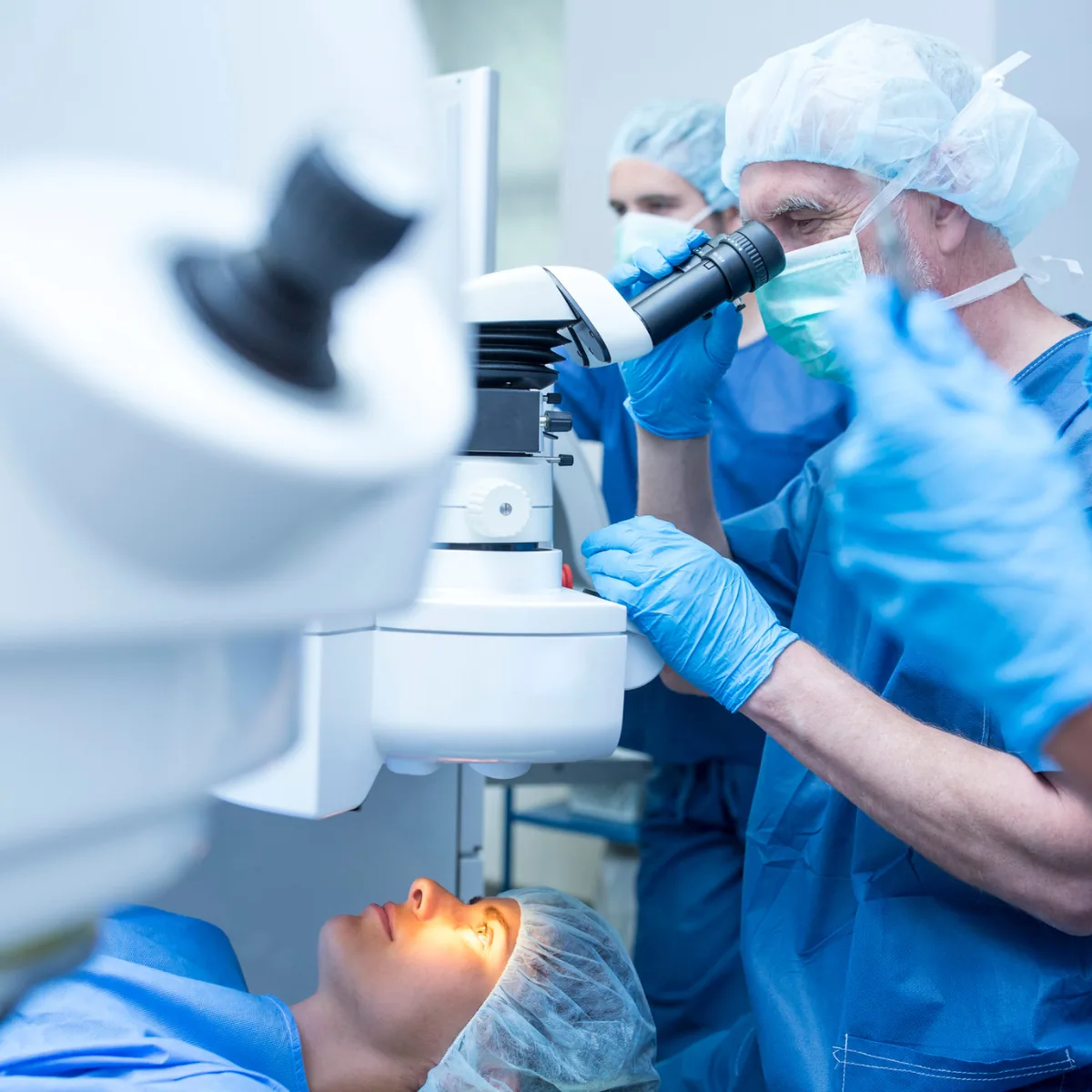
PRK is a "surface" laser refractive surgery technique: the laser acts directly on the cornea, without creating a flap. TransPRK is a no-contact variant. These options are favoured in certain situations, determined by the pre-operative assessment.
PRK (photorefractive keratectomy) is a "surface" laser refractive surgery technique. Unlike Lasik, it does not create a corneal flap: after removing the thin layer of cells covering the cornea, the epithelium, the laser reshapes the corneal surface directly to correct the visual defect. The epithelium then regenerates naturally over a few days. [TO BE VALIDATED BY THE PRACTITIONER: technical description]
Like other laser techniques, PRK aims to redirect the convergence point of light rays onto the retina, correcting myopia, hyperopia, or astigmatism. It is often favoured for thinner corneas or in cases where activities carry a risk of ocular impact.
PRK acts on the surface of the cornea, without a flap. It is one of the oldest refractive surgery techniques and remains in use today for specific profiles.
Schematic, non-anatomical illustration of the three stages of PRK. The actual procedure is explained during the consultation.
And TransPRK?
TransPRK (transepithelial PRK) is a variant in which the laser removes the epithelium and corrects the defect in a single step, without any instrument making contact with the cornea. The optical objective is the same as for PRK; it is only the method of removing the epithelium that differs. [TO BE VALIDATED BY THE PRACTITIONER: technique actually used]
PRK or Lasik: what is the difference?
PRK and Lasik correct the same visual defects, but act on the cornea in different ways. Neither is superior to the other: they suit different eye profiles. [TO BE VALIDATED BY THE PRACTITIONER: exact scope]
PRK, surface laser
No flap: the laser acts directly on the surface after removal of the epithelium. Often favoured for thinner corneas or activities carrying a risk of impact. Visual recovery is more gradual, with possible discomfort in the first few days.
Lasik, with flap
A thin corneal flap is created, then repositioned after laser reshaping. Visual recovery is generally faster, but the technique requires a cornea of sufficient thickness.
No technique is objectively "the best": the right technique is the one that matches your eye, determined by the pre-operative assessment.
Who is it for?
The indication is established after a complete assessment. PRK may be proposed notably:
in cases of a thin cornea or particular corneal profile;
for certain sporting or professional activities carrying a risk of impact;
when Lasik is not the most appropriate option;
in an adult patient with a stable visual defect.
As with all refractive surgery, an ongoing pregnancy and certain eye conditions are contraindications, verified during the assessment.
How does the procedure work?
The procedure is performed on a day-case basis, under local anaesthesia with eye drops, and takes a few minutes per eye.
1
Positioning and anaesthesia
You are positioned lying down and anaesthesia is administered via eye drops, without an injection.
2
Epithelium removal
The thin surface layer of the cornea is removed to expose the area to be treated.
3
Laser reshaping
The laser sculpts the corneal surface according to the correction calculated for your eye.
4
Bandage contact lens
A bandage contact lens is placed to support healing of the epithelium.
What recovery can I expect?
After PRK, visual recovery is more gradual than after Lasik. Discomfort, a sensation of grittiness, watering, and light sensitivity may be experienced in the first few days while the epithelium regenerates.
eye drops prescribed for healing, comfort, and dryness;
bandage contact lens worn for a few days;
visual rest and protection from light;
return to activities in line with instructions given at the consultation;
close follow-up checks.
Key points to know
PRK and Lasik suit different situations: one is not superior to the other, the choice depends on your eye. PRK requires a little more patience during recovery, but remains a reference option for many profiles. The advantages and limitations of each technique are explained during the consultation.
How does the care pathway work with Dr Gattoussi?
The approach is progressive and without obligation: refractive assessment and corneal imaging, information and shared decision, procedure if the indication is confirmed, then close post-operative follow-up. This evaluation draws on Dr Gattoussi's expertise in ocular imaging, which is particularly valuable for a detailed analysis of corneal thickness and shape.
Frequently asked questions
Is PRK painful?
The procedure itself is not painful; it is performed under local anaesthesia with eye drops. Discomfort may be experienced in the first few days during surface healing.
Why choose PRK over Lasik?
The choice depends on corneal thickness and shape, the defect to be corrected, and lifestyle. It is determined by the pre-operative assessment.
How long does it take to recover vision?
Recovery is more gradual than after Lasik, over a few days to a few weeks depending on the individual. Precise timelines are indicated during the consultation.
What is the difference between PRK and TransPRK?
The optical objective is the same. With TransPRK, the laser removes the epithelium and corrects the defect in a single step, without contact.
Is PRK covered by health insurance?
Refractive surgery is generally not covered by the French national health insurance. Some complementary health plans offer a fixed allowance.